Java Development with Cloud

Total Duration : 4 Months

Description to Java Development with Cloud

Java development in a cloud environment combines Java's robust programming features with the scalability, flexibility, and efficiency of cloud computing. In cloud-based Java development, applications are developed and deployed on cloud platforms such as Amazon Web Services (AWS), Google Cloud Platform (GCP), Microsoft Azure, or specialized Java Platform-as-a-Service (PaaS) providers like IBM Cloud or Oracle Cloud.

Why choose the course?

  • High Demand for Cloud Skills: Companies are increasingly adopting cloud technologies, and demand for skilled cloud developers is rising. With expertise in Java and cloud development, you’ll be equipped to work on scalable, secure, and high-performance applications, a skill set highly sought after across industries.
  • Future-Proof Your Career: Cloud computing isn’t just a trend; it’s the future of IT infrastructure. Learning Java development for the cloud ensures you’ll be prepared for long-term job stability as organizations migrate their applications and data to cloud platforms.
  • Versatile Application Development: Java remains one of the most widely used programming languages in cloud development. Knowledge of Java with cloud principles enables you to develop microservices, serverless applications, and containerized solutions that are agile, scalable, and resilient.

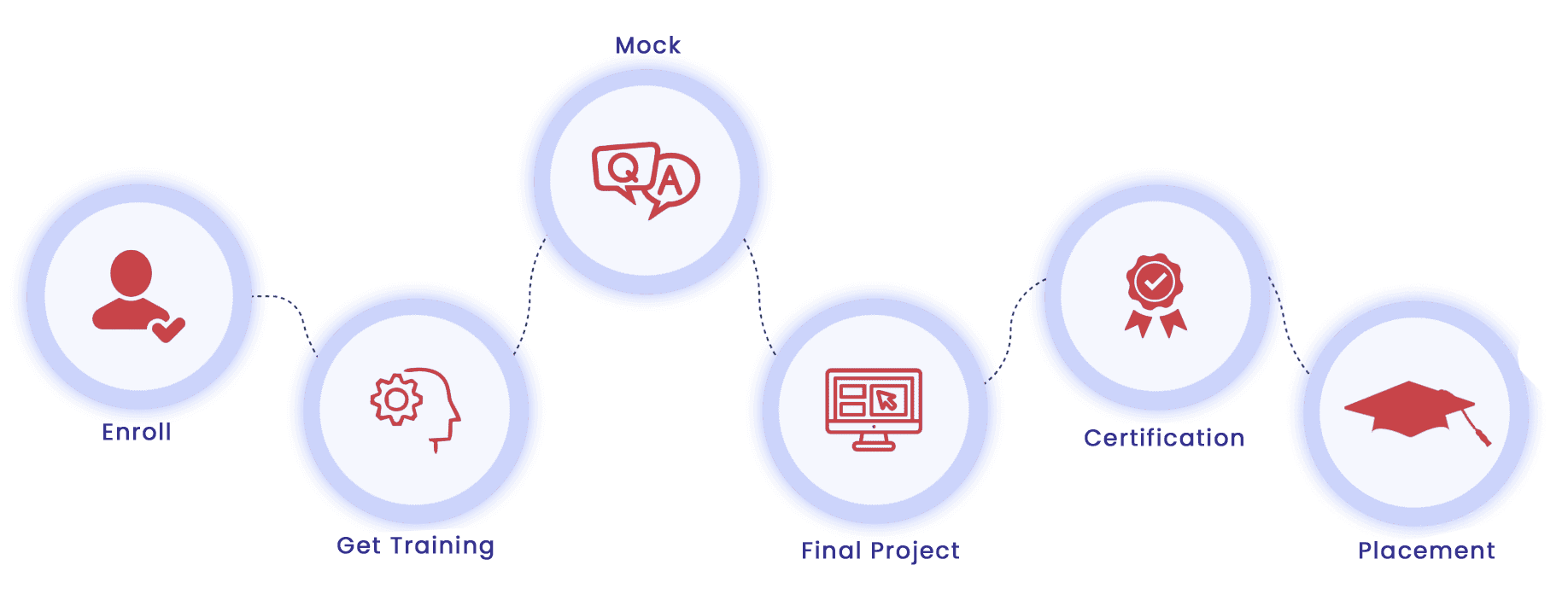
Empeno Journey To Success !

Introduction to HTML CSS

The learning path to the course

  • What is Java?
  • History of Java
  • Features of Java
  • Java Program Execution
  • JVM, JRE and JDK
  • Java Installation
  • How to Set Path in Java
  • Hello World Program
  • Eclipse Installation
  • Java Variables
  • Character Set
  • Java Data Types
  • Operators
  • Keywords
  • If Statement
  • If Else Statement
  • If Else If Ladder Statement
  • Nested If Statement
  • Switch Statement
  • Break
  • Continue
  • For Loop
  • While Loop
  • Do While Loop
  • For Each Loop
  • Class and Objects
  • Methods
  • Packages
  • Access Specifiers
  • Object class
  • Wrapper class
  • Static Keywords
  • Final Keywords
  • Constructor
  • Super Keywords
  • This Keywords
  • Encapsulation
  • Inheritance
  • Polymorphism
  • Abstraction
  • Input and Output Stream
  • Collection Framework
  • Serialization
  • Exception Handling
  • Outer and Inner class
  • Arrays
  • String
  • Properties File
  • Multithreading
  • JVM Memory Management
  • Coding Standards and Debugging
  • Micro Project
  • Mini Project
  • What is MySQL
  • What is database
  • How to install it
  • DDL Statement
  • DML Statement
  • Join Table Query
  • Introduction to HTML
  • Basic HTML Tags
  • Working with Table
  • Working with Form Tags
  • Introduction to CSS
  • Important concept of CSS
  • Practical Concept of CSS
  • JDBC
  • Introduction
  • Hibernate Annotation and CRUD Operation
  • Hibernate Cache Support
  • Hibernate Object State
  • Hibernate Mapping
  • Spring Core
  • Introduction
  • IOC
  • Dependency Injection
  • Stereotype annotation
  • Autowiring
  • Annotation
  • Dependency Checking
  • Required annotation
  • Depends on concepts
  • Spring MVC
  • Singleton Design Pattern
  • Factory Design Pattern
  • Apache Tomcat Server
  • Data Type
  • JSON Object
  • JSON Array
  • Reading data from file
  • Introduction
  • Annotation
  • Architecture
  • Internal working of Spring Boot
  • Advantages of Spring Boot
  • How to create Spring Boot application
  • Spring Boot Starters
  • Actuators
  • Interceptors
  • Spring Boot Mapping
  • Spring Boot Join Query
  • Spring Boot Mail
  • Spring Boot Transection Management
  • Introduction
  • Save Operation
  • Update Operation
  • Get Operation
  • Delete Operation
  • Native Query
  • Fetching data based on different criteria
  • Working with Multiple Profiles
  • Executable Jar Files
  • Exception Handling
  • File Upload
  • Pagination
  • Restful web services annotation
  • What is microservices
  • Advantages and Disadvantages
  • Communication between two microservices
  • Introduction
  • Basic Security
  • JWT Token
  • Bearer
  • Token Expire
  • EC2
  • S3
  • Cloud Watch
  • SNS
  • Load Balancer
  • Autoscaling
  • Terraform
  • EBS
  • RDS
  • Swagger
  • SonarQube
  • AWS Lambda
  • Manual Deployement through Tomcat
  • Automatic Deployement through JENKINS
  • JIRA
  • Git
  • GitHub (Pull Request)
  • Kafka
  • Linux Commands
  • Design Patterns
  • Spring Project with RDS
  • Spring JPA
  • Banking
  • Insurance
  • E-Commerce
  • Capital Market
  • Airline
  • Telecom
  • Java
  • Eclipse
  • Agile
  • GIT
  • GITHUB
  • Azure DevOps
  • Logger
  • Maven
  • Postman
  • STS
  • Junit
  • Mockito
  • Swagger

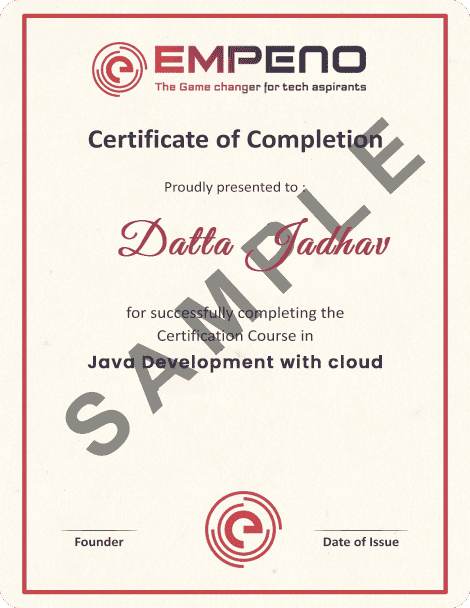
Industry Recognized Certificate

Share your certificate and gain visibility

  • Demonstrate your skills & capabilities
  • Acquire a competitive advantage
  • Grab the attention of recruiters
  • Take a leap towards your first job
Introduction to HTML CSS

The learning path to the course

Basic knowledge of Java programming is typically required. Familiarity with core Java concepts like object-oriented programming and standard libraries is beneficial. Prior experience with cloud platforms is helpful but not mandatory, as most courses cover foundational cloud concepts.

This course prepares you for roles like Cloud Developer, Java Cloud Engineer, DevOps Engineer, and Full-Stack Developer with a cloud focus. It also positions you for certification paths, enhancing prospects in companies prioritizing cloud-first applications and infrastructure.
What's the Difference?

Introduction to HTML CSS